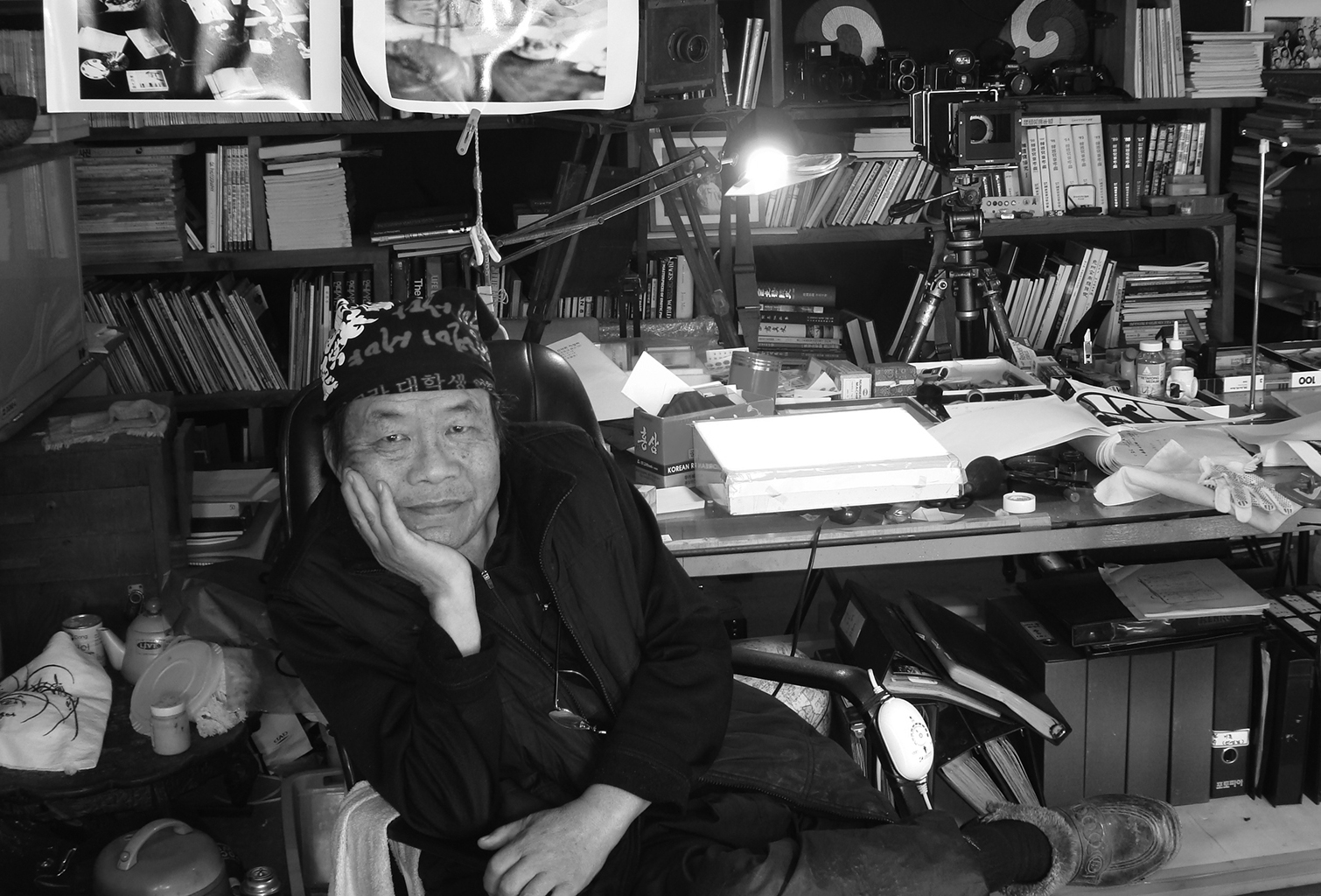
Photo by Se-Rim Oh (Photojournalist at Jeon-buk Newspaper, South Korea)
Choul-Soo Lee is a South Korean photographer. He was born in 1953, in Wha-soon, Jeon-nam province, located in South-Korea. He worked as an ordinary office worker for 18 years and enjoyed taking photographs as a hobby with amateur photographers from a local photograph club. In 1983, he won the first prize in a photograph contest of Ilgan Sports (The Daily Sports Newspaper, South Korea). This was a turning point for him and made him consider a career change to become a professional photographer. His passion to become a professional photographer grew day by day and eventually, at the age 40, he entered the Seoul Institute of Arts in order to study photography.
He developed his own artistic signature while studying by discovering the meaning of photography as an important medium to record our historical era whilst at the same time also appreciating the aesthetic part of the black and white analogue film photography itself and its intricate production process. He perfected the art form with passion. He enjoyed learning all the details of photographic methods as well as be more involved with the photography materials he was using. Inspired by Ansel Adams's dark room process books he set up his own photo studio at Go-chang in 1995 and 1 year later he moved to the Ogungli art village to live with other artists. In this artistic space, he concentrated on developing his darkroom printing techniques by conducting endless visual experiments and printing tests.
While he studied in Seoul Institute of Arts, Myong-sim Yuk (a legendary Korean photographer who has been presenting works dealing with Korean's spirit and identity) was his photography professor and mentor. The relationship between Choulsoo Lee and Myong-sim Yuk has carried on for more than 30 years since that moment.
Myong-sim Yuk understood Choul-soo Lee's passion for darkroom printing techniques and encouraged him to carry on even after his graduation. They often met in Choul-soo's darkroom and reviewed all the gelatine silver prints Choul-Soo produced. All those intensive reviews with Myong-sim Yuk aided Choul-Soo to continue to develop his darkroom skill set over the years. After 1995, they also did several group photographic tours in Tibet, Dharamshala, Bhutan as well as many Buddhist temples in South Korea.
Trusting Choul-soo Lee's photograph printing techniques and fine quality, Myong-sim Yuk started to ask Choul-soo to produce all the gelatine silver prints for his exhibitions, such as: 'The Korean Contemporary Artists', 'Portraits of Artists', 'Baekmin, Ordinary People', 'Jangseung, Totem Poles', and 'Black Sand Bathing' series. And some of those gelatin silver prints collected by The Museum of Photography Seoul published photo book series after digitization.
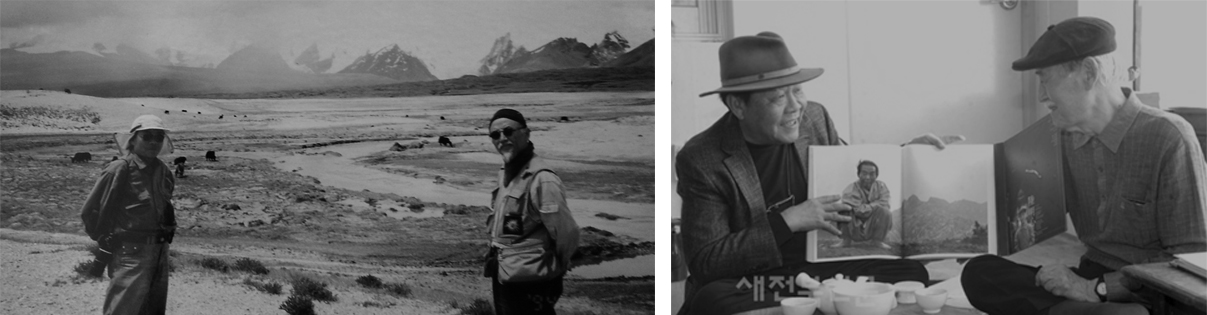
Left photograph, Tibet, 1996. Right Photo by Se-Rim Oh (Photojournalist, South Korea), 2016
In his work, Choul-soo Lee has been focusing on Korean traditional events that are disappearing due to South Korea’s transformation into a modern society. His 'Korean Traditional Funeral', 'Korean Shaman Ceremony', 'Dangsannamu : Village Guardian Deity Tree', and 'Living National Treasure' series were all inspired by his geographical and historical study and research.
One of his remarkable projects is his Yong-dam Dam(*) documentary series. For more than 6 years (1995-2001), he recorded the Yong-Dam dam construction processes from the moment of the Korean government’s announcement to the completion of the dam. This displacements as a result of the dam project created many diasporas who had to leave their land forever and represented a rich local traditional culture and meaningful historical heritages. He approached this project as an ethnographic study. He researched the original geographical Yong-Dam area, and investigated the Dam planning’s impact on the life of the local people, and interviewed most of the local people who had to leave the villages; Yongdam-Myeon, Ancheon-Myeon, Jeongcheon-Myeon, parts of Jucheon-Myeon, Sangjeon-Myeon and part of Jinan-Eup. Over this perios, He took 24,000 black and white photographs and also collected 2500 pieces of local historic legacy.
In 2003, he published a source book highlighting some of 24,000 photographs as well as the legacy materials from the Yongdam area. In 2014, Jinan-Gun (Yong-dam Dam's main area) collected all those photographs and legacy materials and set up Yong-dam Photograph Gallery celebrating the people who had to leave their original village by the dam construction. Choul-Soo Lee currently manages the gallery and organizes exhibitions for the original diaspora and their family and local visitors who want to know the original images of the villages that are now inundated. In 2016, the 'National Institute of Korean History' officially collected all Choul-Soo Lee's Yongdam Dam documentary projects in the section of 'The Archives of Korean History' (archive code DJB039 reproduction is possible, but it is limited to academic use and cannot be published without permission).
(*) The Yongdam Lake is the artificial lake created by Yongdam Dam. Yongdam Dam is the grand freshwater lake formed by submerging 1 Eup and 5 Myeons such as Yongdam-Myeon, Ancheon-Myeon, Jeongcheon-Myeon, parts of Jucheon- Myeon, Sangjeon-Myeon and part of Jinan-Eup. Yongdam Dam is a concrete rockfill dam, 70m high and 498m long. The freshwater capacity is 30km2, the total volume is 815 million tons and the effective volume reaches 682 million tons. Yongdam Dam uses the diversion scheme method. It was built to supply water to the residents in the Jeonju region, Jeollabuk-Do by supplying 1.35 million tons of water per day from the upper Geumgang River to the upper Mangyeonggang River in Sohyang-Ri Gosan- Myeon Gwanju-Gun through the 3.2m diameter and 21.9 km long water conduction tunnel. As the freshwater began to be supplied with the completion of dam construction, Yongdamho Lake became a noted tourists' site not to be missed in Jinan. The route linking Jeongcheon-Myeon, Yongdam-Myeon and Bondaem along the newly relocated road around the dam makes for a fantastic drive in harmony with the superb views of the lake.
이철수는 한국 흑백 사진 작가이다. 1953년 대한민국 전남 화순 출생으로 18년 이상 평범한 직장인으로 근무했다. 그는 아마추어 포토그라퍼로 지역 사진클럽의 회원들과 활동하다가 1983년 데일리 스포츠 신문의 사진 콘테스트에 당선된 후 본격적으로 사진 작가가 되기로 결심하였다. 40세가 되던 해에 서울 예술 대학교에 진학해 사진에 대한 모든 것을 처음부터 다시 시작했다.
그는 흑백 사진의 ‘기록성’과 ‘역사성’에 집중했고 이것이 그가 천착할 분야라고 믿었다. 흑백 사진 생산에 연관된 모든 프로세스와 각 프로세스에서 요구하는 예민한 시각적 훈련에 많은 의미를 두고 실험과 연구를 거듭했다.
1995년 전북 고창에 처음 암실 스튜디오를 세웠다가, 1년 후 지역의 다른 아티스트들과 함께 오궁리 미술촌으로 자리를 옮겼다. 그 곳에서는 미국의 흑백사진 프린트 거장 ‘엔셀 아담스’의 책을 독학하며 암실 흑백 프린트의 모든 생산과정을 스스로 연마했다.
이철수와 서울 예술 대학 사진과의 육명심교수의 인연은 1994년 스승과 제자로 만난 이후로 지속되어오고 있다. 육명심은 이철수의 졸업 후에도 이철수의 인화작업에 대한 질적성장에 많은 영향을 준다. 그들은 1995년부터 한국의 불교 사원뿐만 아니라 티베트, 다람살라, 부탄까지 여러 사진 그룹 투어를 가지며 작가로서의 대화를 이어오고 있다. 육명심은 그의 대표작들인 '한국 현대 미술가', '예술가의 초상', '백민, 평범한 사람들', '장승, 토템폴', ‘모살뜸, 검은 모래찜질’의 흑백 암실 인화를 이철수와 작업한다. 파인 아트급 젤라틴 실버 프린트 흑백 사진들은 육명심의 대형 전시회에 전시되고, 갤러리에 소장되었으며, 디지털스캔 후 출판되었다. 그는 오직 오리지널 흑백 필름 사진과 인화에만 몰입해왔다.
이철수는 '한국 전통 장례식', '한국 무당’, ‘당산 나무’, ‘무형문화재’ 시리즈 등 한국이 현대 사회로 변모하면서 사라지고 있는 한국전통의 풍습을 기록하는 것에 집중해왔다. 그의 주목할만한 프로젝트 중 하나는 6년(1995-2001)에 걸친 기록 다큐멘터리인 ‘용담댐 수몰지구’ 시리즈다. 그는 민족지학적 관점으로 용담댐 개발과정에 주목하고, 지역의 전통문화와 역사를 이어가던 주민들이 정부의 수력자원 개발정책에 의해 강제로 수몰민이 되어버린 '디아스포라의 스토리'를 사진, 인터뷰, 수집을 통해 연구하였다. 그는 이 연구과정을 위해 24,000여장의 흑백사진필름 기록과 수몰현장에서 버려진 2500여 점의 지역유산을 수집하고 정리하였고, 2003년에 그 흑백사진과 유물을 설명하는 자료집을 자비로 발간했다.
수집된 내용 중에는 용담지역의 고문서, 호구단자, 용담댐 건설에 따른 이주대책과 주민 요구사항 기록, 수몰민들의 일기장이나 금전출납부, 주민들의 탄원서, 해방 후의 농지분배예정 통지서, 지역 계문서, 지도 등 지역 역사에 유의미한 자료들이 포함되어 있다. 2014년 진안군(용담댐 본관)은 이철수에게 ‘용담댐 다큐멘터리’의 사진과 유산 자료를 기증받아 ‘용담 사진 문화 갤러리’를 설립하였고 모든 자료를 디지털 아카이브화 하였다. 2016년에는 '국사편찬위원회' 에서 공식적으로 이철수의 모든 흑백사진자료와 유물들을 '전북 진안군 용담댐 수몰민의 애환이 담긴 용담사진관 소장 근현대 자료'(사료군 DJB039)로 등록하였다.
용담댐 부가설명: 용담호는 용담댐이 만든 인공 호수이다. 용담댐은 용담면, 안천면, 정천면, 주천면 일대, 상전면 일대, 진안읍 일대 등 1읍 5면을 침수시켜 형성된 담수호다. 용담댐은 높이 70m, 길이 498m의 콘크리트 암석 댐이며 담수 면적은 30km2, 총 용적은 8억 1500만톤, 유효 용적은 6억 2천 2백만 톤에 이른다. 금강 상류에서 소향리 고산면 광주군 만경강 상류까지 3.2m를 통해 하루 135만 톤의 물을 공급하여 전북 전주 지역 주민들에게 물을 공급하기 위해 지어졌다. 댐 공사가 완료되고 담수 공급이 시작되면서 용담호는 명승지가 되었다.